Managed Workforce Operations, Enhanced by AI
Smarter, faster workforce support, grounded in human expertise.
Emplia is a managed workforce operations service built for complex HR, payroll, and workforce environments. Our specialists own service delivery, while AI helps automate repetitive guidance, triage, and knowledge tasks. Get faster support, a lower cost-to-serve, and a consistent multilingual experience, without giving up human control.
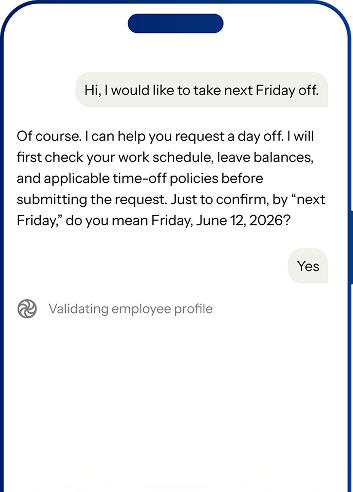
 AI-assisted efficiency
  Multilingual workforce delivery
  Cross-system workforce operations
  Managed-service accountability

Workforce support spans multiple systems.
Your support model should too.
With different platforms for HR, payroll, workforce management, policy, access, and ticketing, system-specific assistants may help in one application, but cross-system service still need coordinated ownership and human expertise.
Fragmented across HR, payroll, and workforce systems.
Point AI tools limited to individual systems.
Repeated questions and manual triage.
Inconsistent language coverage.
Specialist time lost to routine support and exceptions.
Unclear routing and ownership.
One managed service for workforce support,
from question to resolution.
Emplia in Action
A single service experience from question to resolution, preserving context and ownership throughout.
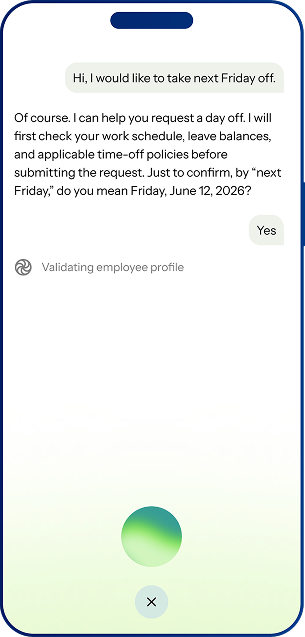
An employee or manager reaches Emplia with a workforce question or request.
Emplia provides approved guidance or gathers the context needed to move the case forward.
Managed-services specialists execute routine work, coordinate requests, and preserve context across handoffs.
Functional or technical exceptions are escalated to the right owner with the case history attached.
Service data, recurring issues, and outcomes feed reporting, knowledge updates, and targeted automation.
How Emplia delivers managed workforce support
Employees get a simple support front door, while Emplia coordinates the service behind it,
using approved knowledge, managed-services specialists, and AI-assisted automation.
1
Receive Questions
and Requests
Employees and managers contact Emplia for guidance, status, support, or operational action.
2
Apply
Context
Emplia uses approved organizational knowledge, case history, and agreed operating rules to understand what is needed.
3
Resolve, Execute,
or Escalate
AI handles suitable repetitive guidance; Emplia specialists own transactions, interpretation, exceptions, and coordination with the appropriate client or technical team.
4
Improve and
Optimize
Case patterns, outcomes, and service data feed reporting, knowledge updates, root-cause analysis, and targeted automation opportunities.

Turn workforce support friction into operational freedom

Lower cost-to-serve
Use standardized managed services and targeted AI assistance to reduce repetitive support effort and avoid linear headcount growth.

Faster responses
Provide immediate guidance for suitable questions and clearer routing for requests that require action.

Less repetitive workload
Free internal HR and payroll specialists to focus on higher-value work, complex cases, and business priorities.

Consistent, accountable service
Apply defined procedures, service levels, case ownership, and escalation paths across workforce support.

Multilingual reach
Configure service by language, geography, and coverage hours to support distributed workforces.

Measurable performance
Track volumes, service levels, escalations, satisfaction, recurring issues, and improvement opportunities.









Enterprise-ready support with controls
built into the operating model.
Workforce operations involve sensitive employee information and, in some environments, transactions affecting financially relevant processes. Emplia is designed to work within each client’s security, privacy, and internal-control framework, with documented ownership, controlled access, and traceable service delivery.
SOX-aligned controls
Defined roles, approval paths, segregation of duties, traceable case handling, and evidence retention designed to support client internal-control requirements where applicable.
GDPR-aware data handling
Purpose limitation, data minimization, role-based access, and controlled retention practices designed to support GDPR requirements for European workforce data.
Privacy by design
Use only the workforce information required for the agreed service, with client-approved knowledge, permissions, and processing rules.
Access and accountability
Least-privilege access, human ownership of sensitive actions, documented escalations, and traceable approvals.
Client systems stay authoritative
HR, payroll, and workforce platforms remain systems of record; Emplia operates within agreed integrations, permissions, and service boundaries.
Governance and auditability
Documented SOPs, case history, service reporting, and change or exception logs support client governance and assurance activities.
For Canadian deployments, privacy controls are scoped to the applicable client environment, including relevant federal and Québec privacy requirements.
Compliance scope is defined with each client. Emplia’s service controls are designed to support client compliance obligations and do not constitute a blanket certification or replace the client’s legal, privacy, audit, or internal-control responsibilities.
Start with a focused managed-services pilot
Prove the service model, operational fit, and cost-reduction
opportunities in a controlled scope before scaling.



Emplia FAQs
What is Emplia?
Emplia is a managed workforce operations service for enterprise HR, payroll, and workforce support. We combine multilingual specialists, defined service levels, and governance with AI-assisted guidance and automation to improve speed, consistency, and cost-to-serve.
Is Emplia an AI platform or a managed service?
Emplia is a managed service. AI is an enabling layer within the service model, used where appropriate for repetitive questions, knowledge retrieval, triage, and workflow assistance. Human specialists remain accountable for transactions, exceptions, and service outcomes.
How does Emplia help reduce workforce support cost?
By combining standardized managed-service processes with targeted AI assistance, Emplia reduces repetitive contacts, manual triage, and unnecessary specialist effort. The objective is a lower cost-to-serve while preserving service quality, human accountability, and measurable performance.
Which workforce systems can Emplia support?
Emplia is designed to support workforce processes that span HR, payroll, workforce management, ticketing, and related enterprise systems. The exact platforms, integrations, and responsibilities are defined with each client during discovery and pilot design.
Does Emplia replace our HR or support team?
No. Emplia acts as an extension of your HR, payroll, and support teams. We take on agreed operational work and repetitive support so internal specialists can focus on higher-value priorities, while your organization retains policy and system authority.
Which languages does Emplia support?
Initial planned delivery languages are English, French, Finnish, and Spanish. Language availability, service hours, and future expansion are defined according to the client scope.
How does an Emplia pilot work?
A pilot starts with a controlled group of users and use cases, approved knowledge, defined service levels and escalation paths, and agreed success measures. Emplia then launches, measures, and tunes the service before expanding populations, processes, languages, or integrations.
How are sensitive or complex questions handled?
Sensitive, complex, or action-oriented cases are routed to human specialists under defined escalation rules. Client systems remain the systems of record, and access, content, privacy, and governance controls are built into the operating model.
How does Emplia approach SOX, GDPR, and data privacy?
Emplia is designed to operate within client-defined security, privacy, and internal-control requirements. Depending on scope, controls can include role-based access, segregation of duties, traceable approvals and case history, data minimization, controlled retention, and documented escalation. For SOX and GDPR, Emplia supports the client’s control and compliance environment rather than replacing the client’s legal, audit, or compliance responsibilities.